
00 THERMAL RESTORATION
Blown-In Insulation in Dallas-Fort Worth
Restore your home's thermal boundary and block out the brutal Texas heat. Our professional-grade blown-in fiberglass upgrades attic R-value and helps reduce heat gain across the home.
01 The Mandate
Why DFW Homes Need Blown-In Insulation.
Across the Dallas-Fort Worth metroplex, the vast majority of homes simply lack the adequate thermal shielding required to handle the brutal, unrelenting Texas sun. When builders construct homes, they typically only lay down the bare minimum legal requirements.
Combating Texas Heat
The science is undeniable: heat naturally moves toward cold spaces. In July and August, when your attic reaches 140°F, that massive thermal load presses relentlessly down through your ceiling drywall and directly into your air-conditioned living room.
Establishing a thick, continuous blanket of blown-in fiberglass drastically slows this thermal transfer. Elevating your attic to the Department of Energy's recommended R-38 to R-60 rating acts as a massive thermal blockade. A proper install can improve comfort and lower cooling demand, with the exact energy impact depending on the home's starting insulation depth and air leakage.
Moisture Control in North Texas
While primarily utilized to block heat, establishing a thick layer of blown-in insulation directly aids your home's moisture management ecosystem. By properly separating the conditioned air space beneath your ceiling from the uncontrolled attic air above it, we neutralize the dew point within your attic floor. This practically eliminates drywall moisture staining and stops toxic mold blooms.
02 Engineered Approach
Blown-In Options.
Virgin Fiberglass
Our premier choice for 95% of North Texas attics. We utilize virgin, professional-grade fiberglass specifically manufactured for loose-fill pneumatic installation.
- CAPABILITY_01: Non-combustible fire safety
- CAPABILITY_02: Resists moisture & mold growth
- CAPABILITY_03: Formaldehyde-free composition
Dense Cellulose
Manufactured from recycled materials treated with non-toxic boric acid. Cellulose provides an incredibly dense packing structure perfect for noise dampening.
- SPEC_01: Superior acoustical deadening
- SPEC_02: Higher thermal resistance per inch
- SPEC_03: Ideal for drafty, odd ceiling layouts
03 Pipeline
Operational Protocol.
Infrared Assessment
Technicians deploy thermal imaging cameras to visibly expose where your home is suffering from localized heat gain, confirming exactly how much material is required.
Area Sub-Ventilation
We install custom baffles around edge-soffit vents to ensure healthy attic airflow is never choked, and establish protective air-chutes around active heat sources.
Pneumatic Application
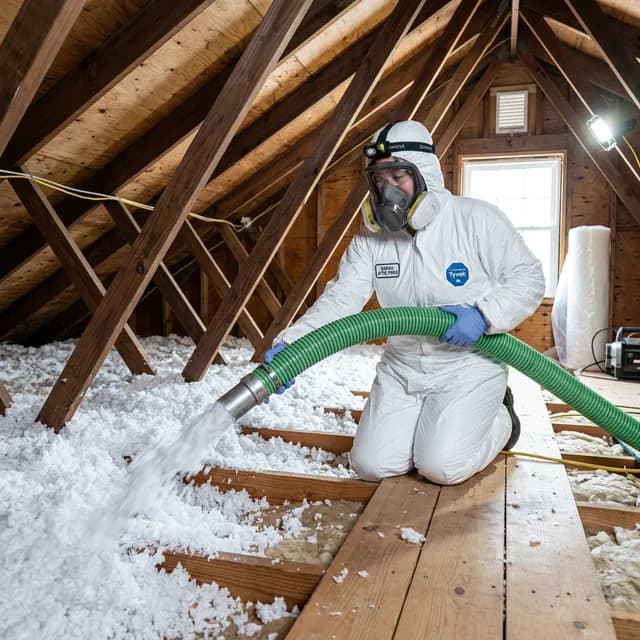
A high-powered external hopper establishes a meticulously aerated stream of insulation, blown deeply and evenly across your entire attic floor architecture.
Quality Verification
We utilize structural depth rulers exactly measured to the target R-value to empirically verify the attic is flawlessly covered with zero ambient cold spots.
04 Financial Scope
Capital Expenditure Factors.
Variable 01
Target Depth (R-Value)
Building a fresh R-38 level directly over bare drywall requires significantly more raw loose-fill material than simply "topping off" a declining existing R-19 layer.
Variable 02
Prep Architecture
Extremely steep roof pitches or complex HVAC ductwork webs may require custom baffling or specialized application labor routes to successfully hit our rigorous depth tolerances.
Maximum ROI: Available Rebates & Tax Credits
The federal 25C credit for insulation-related envelope work expired after Dec 31, 2025. In 2026, blown-in savings come from current local utility rebates when the attic condition and finished scope qualify under programs such as Oncor (rebate availability varies by provider).
05 INQUIRIES
Common Diagnostics.
Q.1How long does blown-in insulation last?
High-quality fiberglass or cellulose can effectively block heat transfer for 20 to 30 years if installed precisely and kept completely dry within the attic ecosystem.
Q.2Can you add blown-in insulation over existing insulation?
Yes, as long as the existing insulation is completely dry, free of mold, and lacks prior pest pheromones. If sterile, new blown-in insulation successfully layers on top to instantly compound your R-value.
Q.3Why should I choose blown-in insulation over batts?
Blown-in effectively acts as a liquid solid. It naturally flows into odd-shaped cavities, completely surrounding wiring, un-even joists, and plumping lines. This monolithic ceiling layer drastically reduces air leaks compared to manually cut batts.
Lock It
Down.
Ready for a more comfortable, efficient home? Authorize a detailed thermal assessment today.
Systems & Hubs
Related Insulation Services
Technical Resources
Major Hubs Served
Get Started.
Schedule your free on-site insulation inspection directly into our system.