
00 PREMIUM SEALING
Spray Foam Insulation in Dallas-Fort Worth
Stop your AC from fighting a losing battle against 140-degree DFW summer heat. Our premium spray foam helps seal the home's envelope, reduce attic heat load, and improve overall comfort.
01 The Mandate
Why DFW Homes Need Spray Foam.
Traditional fiberglass insulation simply acts like a dirty filter, allowing superheated air and humidity to pour directly into your living spaces. Spray foam insulation changes the physics of your home by creating a clinical, airtight thermal barrier.
Combating Texas Heat
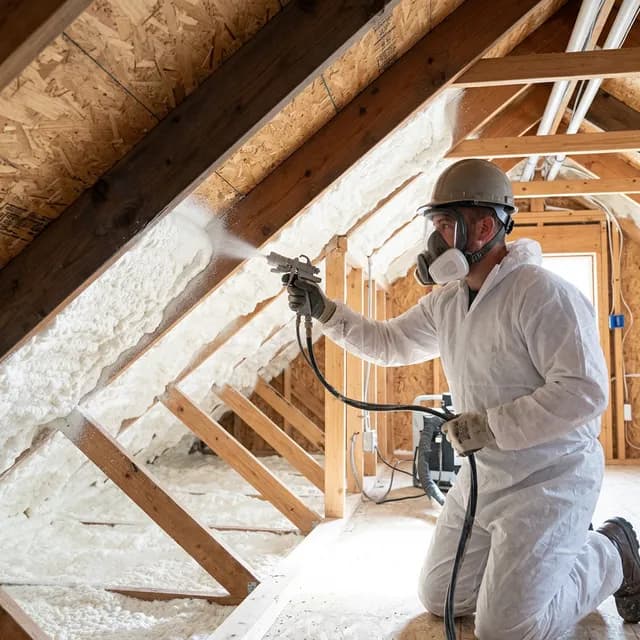
During July and August, a typical DFW attic can easily reach temperatures exceeding 140°F. When you have ductwork running through this superheated environment, your AC compressor has to work twice as hard to push 60°F air out of your vents. By applying spray foam to the underside of your roof deck (encapsulation), we bring your attic into the conditioned envelope of your home.
The results are immediate: attic temperatures can drop significantly, allowing HVAC equipment to run more efficiently and helping reduce short-cycling. The exact energy impact depends on roofline design, existing leakage, and how much of the attic system is addressed in the project.
Moisture Control in North Texas
It's not just the heat; the humidity in North Texas can cause massive problems. Condensation within wall cavities and attics can lead to rapid mold growth and wood rot. Closed-cell spray foam acts as a complete vapor barrier, locking out exterior moisture entirely. This is essential for homes near lakes or highly humid local micro-climates, vastly improving indoor air quality and ensuring a healthier environment for your family.
02 Engineered Approach
Spray Foam Options.
Open-Cell Polyurethane
An incredibly effective thermal barrier that expands up to 100 times its original liquid size. It is perfect for filling nooks, crannies, and oddly shaped wall cavities.
- SPEC_01: Superb sound dampening profile
- SPEC_02: Economical for massive attics
- SPEC_03: R-3.8 per inch thermal resistance
Closed-Cell Rigid Foam
The ultimate in thermal protection. Closed-cell foam is dense, rigid, and acts as a complete class-1 vapor barrier while significantly enhancing structural racked strength.
- SPEC_01: Massive R-7.0 per inch yield
- SPEC_02: 100% moisture & vapor barrier
- SPEC_03: Enhances sheer wall racking strength
03 Pipeline
Operational Protocol.
Thermal Assessment
We conduct a comprehensive thermal imaging scan and mechanical audit of your attic and wall cavities to determine exactly where you are leaking energy.
Clinical Preparation
Our technicians establish a clinical staging area. We cover floors, seal off HVAC registers, and create negative pressure to ensure no fumes breach the envelope.
Foam Application
Using state-of-the-art heated proportioners, master installers apply the precise ratio of foam to encapsulate your roof deck or wall cavities perfectly.
Quality Verification
Once the foam cures within minutes, we conduct a final thermal scan to confirm coverage, review any remaining leakage points, and then thoroughly clean the workspace.
04 Financial Scope
Capital Expenditure Factors.
Variable 01
Foam Density Profile
Open-cell foam generally ranges from $1.50 to $2.50 per board foot, whereas premium closed-cell scales from $3.00 to $5.00 due to its significantly higher chemical density and vapor locking properties.
Variable 02
Geographic Scope of Work
A full surgical attic encapsulation spanning the entire roof deck will carry a higher expenditure than an isolated retrofit on an exterior knee wall or crawlspace.
Offsets: Available Rebates & Tax Credits
Please note: The federal 25C Energy Efficient Home Improvement Credit expired on Dec 31, 2025. However, local utility providers like Oncor still offer rebates for qualifying insulation work. Rebate availability varies by provider and program year.
05 INQUIRIES
Common Diagnostics.
Q.1How much does spray foam insulation cost in Dallas-Fort Worth?
Costs vary based on square footage, but typically range between $3 to $5 per square foot for closed-cell foam in the DFW metroplex.
Q.2Does spray foam insulation actually help with AC cooling in Texas?
Yes. It can reduce attic heat gain and help your AC run more efficiently during the Texas summer, especially when major leakage points are sealed as part of the same project.
Q.3Is spray foam insulation safe for my home?
Yes, once completely cured. It becomes an inert solid that actually improves indoor air quality by sealing out exterior pollutants, humidity, and allergens.
Lock It
Down.
Ready for a more comfortable, efficient home? Authorize a detailed thermal assessment today.
Systems & Hubs
Related Insulation Services
Helpful Articles
Get Started.
Schedule your free on-site insulation inspection directly into our system.