
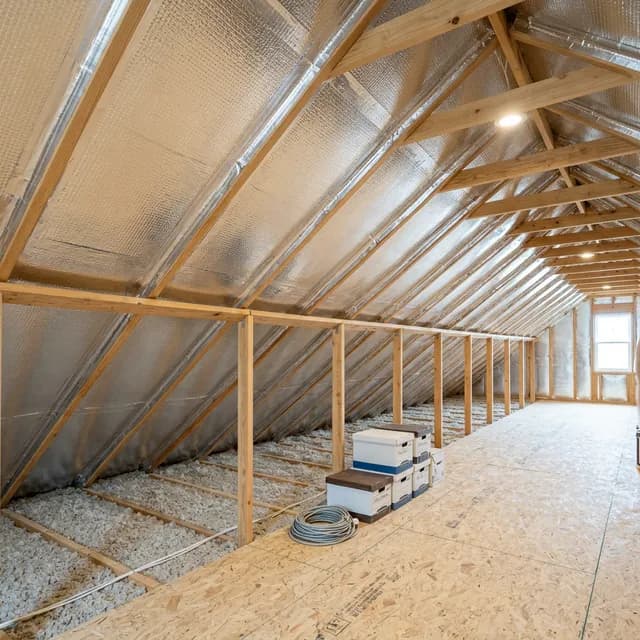
00 THERMAL REFLECTION
Radiant Barrier Installation in Dallas-Fort Worth
Turn your attic into a thermal fortress. Our professional radiant barrier installations act like a massive mirror, deflecting 97% of the sun's punishing heat waves before they ever penetrate your living space.
01 The Mandate
Why DFW Homes Need Radiant Barrier.
When examining building science, heat transfers in three distinct ways: conduction (touching a hot pan), convection (hot air circulating through an oven), and radiation (the feeling of the sun violently beating down on your skin). If you live in Dallas-Fort Worth, radiant heat is your primary enemy.
Combating Texas Heat
During the peak of a Texas summer, the sun pummels your roof with intense electromagnetic radiation for up to 14 hours a day. This invisible energy cuts directly through the shingles, decking, and open attic air space, crashing violently into your air conditioning ductwork and floor insulation. Once those materials absorb that radiant energy, they superheat, turning your entire attic into a 150°F active radiator pushing heat down into your home.
Deploying a continuous, highly reflective radiant barrier physically stops this process at the roofline. Acting exactly like a mirror reflecting light, the foil skin aggressively bounces up to 97% of that incoming electromagnetic radiation right back out into the sky. Studies from the Department of Energy indicate homes equipped with a proper radiant barrier yield energy savings data reflecting a 10% to 15% immediate drop in overall AC cooling costs.
Moisture Control Dynamics
Modern radiant barrier systems are deliberately manufactured to be highly perforated. Why? Because North Texas suffers from intense humidity swings. High-performance perforated barriers allow vaporized moisture to safely and continuously pass through into the upper attic airflow vents, effectively preventing mold development while retaining immense reflective power.
02 Engineered Approach
Radiant Barrier Options.
Foil-Faced Radiant Rolls
The gold standard in residential heat deflection. We meticulously staple highly reinforced, double-sided, multi-layered aluminum foil directly to the underside of your roof rafters.
- CAPABILITY_01: Maximum 97% reflectivity rating
- CAPABILITY_02: Industrial woven mesh core
- CAPABILITY_03: Micro-perforated moisture release
Spray-Applied Barriers
Intended exclusively for attics featuring exceedingly complex roof pitches, truss architectures, or extraordinarily tight clearances where rolling physical foil is impossible.
- SPEC_01: Covers complex truss systems
- SPEC_02: 75-80% radiant reflectivity
- SPEC_03: Micro-bonds intimately to decking
03 Pipeline
Operational Protocol.
Attic Geometry Mapping
Our technicians analyze the specific pitch, truss structure, and architectural layout of your roof to determine the exact material trajectory for a continuous envelope.
Baseline Diagnostics
We take baseline surface temperatures of the raw roof decking and attic air space so we can compare pre-install and post-install conditions.
Precision Application
We stretch and industrially staple the reinforced aluminum across the rafters, ensuring a minimum 2-to-3 inch air gap is fiercely maintained behind the material.
Ventilation Clearance
A blocked vent ruins an installation. We meticulously trim and clear all foil edges away from ridge vents, gable fans, and soffit intakes to ensure critical passive airflow remains unhindered.
04 Financial Scope
Capital Expenditure Factors.
Variable 01
Roof Surface Area
A two-story home with a steep 12/12 pitch has drastically more roof surface area requiring foil coverage than a sprawling one-story ranch home.
Variable 02
Attic Navigability
Very cramped attics featuring intersecting, low-clearance trusses require significantly more manual labor hours carefully measuring and cutting foil around structural obstacles.
Maximum ROI: Available Rebates & Tax Credits
The federal 25C credit for insulation-related envelope work expired after Dec 31, 2025. In 2026, any radiant-barrier savings discussion should focus on current local utility rebates and whether the full attic scope qualifies under active program rules.
05 INQUIRIES
Common Diagnostics.
Q.1Does a radiant barrier actually work in Texas?
Yes. In the extreme Texas sun, an attic can easily reach 150 degrees. A radiant barrier acts like a mirror, bouncing 97% of that radiant heat back out of the roof before it can bake your home.
Q.2Can radiant barrier replace regular attic insulation?
No. They serve two entirely different functions. A radiant barrier blocks the sun's electromagnetic heat waves (radiant heat), while physical insulation blocks conductive air transfer. You need both to create a complete thermal envelope.
Q.3Will a radiant barrier damage my roof shingles?
No. Extensive studies by the Florida Solar Energy Center empirically prove that radiant barriers only increase ambient shingle temperature by 2 to 5 degrees, which is well within their design tolerance and does not void standard manufacturer warranties.
Lock It
Down.
Ready for a more comfortable, efficient home? Authorize a detailed thermal assessment today.
Systems & Hubs
Related Insulation Services
Technical Resources
Major Hubs Served
Get Started.
Tell us what your home needs. We’ll reply within 24 hours with vetted pros and our honest recommendation.