
00 INDUSTRIAL GRADE
Commercial Insulation in Dallas-Fort Worth
Stop bleeding capital through your roof. Our industrial-grade thermal encapsulation solutions help large DFW facilities reduce heat gain, improve comfort, and support more efficient HVAC performance.
01 The Mandate
Why DFW Businesses Need Commercial Insulation.
Operating a massive commercial facility in North Texas presents unique, highly expensive building science challenges. When the thermal envelope is compromised, the immense HVAC loads required to combat the climate quickly destroy corporate profitability.
Combating Texas Heat
In July and August, the punishing Dallas sun turns uninsulated metal roofs and tilt-wall concrete into colossal radiators. A 50,000 square foot warehouse without an engineered thermal break will easily surpass 120°F internally. This obliterates employee productivity, risks destroying temperature-sensitive inventory, and forces massive 20-ton commercial AC condenser units to red-line continuously, radically shortening their mechanical lifespan.
By deploying industrial-grade spray polyurethane foam or high-density blow-in directly against the roof decking, we dramatically reduce heat transfer. Facilities that undergo comprehensive thermal upgrades often see lower cooling demand and more predictable operating costs, with performance varying by building type and baseline conditions.
Moisture Control in North Texas Humidity
Beyond temperature control, large raw-metal structures are notoriously vulnerable to extreme interior condensation. In the wild humidity swings of North Texas, warm interior air violently condenses the moment it touches cold roof steel during a brief winter chill. This causes the building to "sweat"—literally raining indoor moisture down onto merchandise and electrical systems, while aggressively rusting the structural frame. A fully seamless, closed-cell insulation installation acts as an absolute Class 1 vapor retarder, permanently neutralizing the dew point and halting commercial structure corrosion.
02 Engineered Approach
Industrial Scale Options.
Commercial Closed-Cell
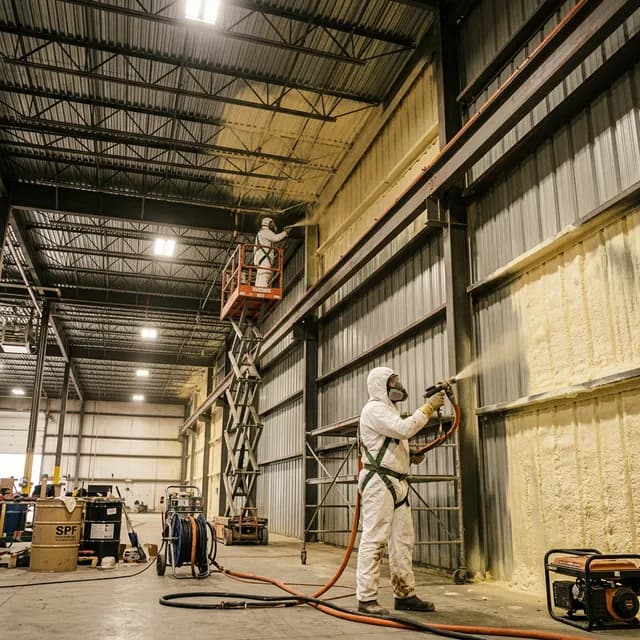
The heavyweight champion of industrial insulation. This dense chemical polymer violently expands and solidifies, completely fusing with the metal structure to provide unmatched R-value and structural rigidity against high-shear wind loads.
- CAPABILITY_01: Yields R-7.0 per inch
- CAPABILITY_02: 100% monolithic water barrier
- CAPABILITY_03: Halts metal building sweating
High-Yield Blown-In
Designed specifically for massive commercial office drops and sprawling flat-roof truss cavities. We utilize massive, truck-mounted pneumatic blowers capable of laying down thousands of square feet of thick, virgin fiberglass per hour.
- SPEC_01: Tremendously cost-effective for scale
- SPEC_02: Meets stringent non-combustible codes
- SPEC_03: Superb acoustical dampening
03 Pipeline
Operational Protocol.
Industrial Scoping
Commercial projects require heavy logistical planning. Our engineers analyze the total volume, survey specific HVAC zoning loads, and calculate precise material depth requirements to meet targeted energy goals.
Asset Protection
Spray foam application is highly pressurized. We execute massive containment protocols, wrapping heavy machinery, sensitive inventory, and active assembly belts in industrial plastic sheeting.
High-Volume Application
Utilizing commercial-grade, diesel-powered proportioning rigs, technicians systematically spray thousands of square feet of expanding polymer, rapidly establishing an impenetrable thermal wall.
Ventilation & Air Quality Sign-Off
Because commercial facilities are densely populated, we run massive localized exhaust fans to rapidly cure the foam within hours. We ensure total VOC dissipation before releasing the space back to your workforce.
04 Financial Scope
Capital Expenditure Factors.
Variable 01
Material Chemistry
Deploying dense, waterproof closed-cell spray foam requires significantly more raw chemical volume and higher application pressure than standard blown-in fiberglass, inherently elevating the total contract value despite its superior longevity.
Variable 02
Volume Economics
Commercial bids require calculating the raw three-dimensional volume of material being laid down, aggressively scaling with facility dimensions. Total cost universally decreases per-inch as overall square footage scales up.
Maximum ROI: Available Rebates & Tax Credits
The financial incentives for green-upgrading commercial real estate are enormous. Building owners can leverage section 179D of the federal tax code for massive energy-efficiency tax deductions, and local grid providers (ERCOT) aggressively issue commercial rebates to large consumers who lower their peak kilowatt demand through certified thermal upgrades.
05 INQUIRIES
Common Diagnostics.
Q.1Can you spray foam commercial metal buildings?
Yes. In fact, closed-cell spray foam is highly recommended specifically for metal buildings. It permanently prevents condensation (sweating) while providing massive structural rigidity and an impenetrable vapor barrier.
Q.2Does commercial insulation reduce HVAC costs?
Dramatically. By clinically sealing the thermal envelope of a large commercial space, massive rooftop HVAC units cycle far less frequently, greatly extending their mechanical lifespan and drastically cutting monthly electrical overhead.
Q.3Can The Very Good Home Company handle large-scale commercial insulation projects?
Yes. We operate industrial, truck-mounted proportioner rigs strictly calibrated for high-volume foam and fiberglass output, specifically designed to handle sprawling commercial footprints across the DFW metroplex.
Lock It
Down.
Protect your assets and stop bleeding operational capital through your roof. Schedule a comprehensive commercial scoping today.
Systems & Hubs
Core Insulation Services
Technical Resources
Major Commercial Hubs Served
Get Started.
Schedule your free on-site insulation inspection directly into our system.